Parental Alienation (part 1)
www.dedicatedfathers.org
BY: Marvin L. Chapman
Within the mental health field there continues to be an ongoing debate as to whether or not there is such a thing as parental alienation. Some research appears to support the notions behind parental alienation and its effects on children, and yet other research appears to refute it. However, for those of us in the trenches - especially those of us who have spent years in the family court arena - there is no doubt about parental alienation and its consequences.
Parental alienation is generally defined as one parent repeatedly and continuously programming or brainwashing their child against the other parent. Parental alienation may include such acts as obstructing, interfering or outright denying the child’s right to spend time with the other parent. It usually includes statements that the other parent does not care about the child, is too busy for the child, or similar statements all used to coerce the child into believing the other parent and even their extended family do not love the children or care about them anymore. Such begins the breaking down of the parent-child relationship. In its worst form, parental alienation involves false allegations of abuse, neglect, or some other form of alleged harm to the child.
Of the research I have read, most of those opposing the notion of parental alienation have a clear bias towards mothers. This is not surprising given the fact the mother is almost always the parent who attempts to alienate the children, very seldom the father. Those who oppose the notion of parental alienation overwhelmingly state that if there is any real alienation, then it comes from the fathers’ own actions and not due to any wrongdoing on the part of the mother. It appears to me that those who buy into the notion only mother’s can nurture and care for children also buy into the notion that mother’s would never purposefully and systematically alienate the children against their father.
In over 26 years within the family courts, I can categorically state parental alienation is very real in family law. Anyone spending half a day in any family court will clearly see the systematic alienation that is perpetrated in many cases (but then going to court and finding out what really goes on is NOT scientific study - it’s REALITY). Some form of parental alienation is in about fifty percent (50%) of all of my cases as indicated by the following:
The number 1 complaint of all fathers I have seen in over 25 years is that the mother is causing interference, obstruction and denial of their children’s right to spend time with the father.
The number 2 complaint of all fathers I have seen in over 25 years is that the mother is repeatedly and continuously making degrading and derogatory remarks about the father either directly to the children, or at the very least within hearing distance of the children.
The number 3 complaint of all fathers I have seen in over 25 years is that the mother prevents or severely limits the father from having any significant say in the lives of their children as to health decisions, educational decisions, extra-curricular activities and other general welfare decisions - actions which are made solely and unilaterally by the mother.
As stated above, I have found some form of parental alienation in about fifty percent (50%) of all of my cases for over 26 years as outlined above. Therefore, for me and my clients, parental alienation is extremely common. No only are these acts alienating the children, I support the notion that such acts rise to the level of child abuse. It is abusive for one parent to interfere, obstruct or denial children their right to spend time with the other parent. It is abusive for one parent to continuously make degrading and derogatory remarks about the other parent, whether directly to the children or within hearing distance of the children. And it is abusive for one parent to make sole unilateral decisions about the children without any significant input from the other parent - basically cutting the other parent out of the decisions making process for their children.
Unfortunately, what I call child abuse, family court judges call “primary physical custody to mother.” I see hundreds of clients each year and in over half of those cases I hear at least one (1) of the complaints outlined above. Extrapolate those numbers to the general population and we can only guess at the real number of children being abused through the alienation action of their mother.
The reasons one parent alienates the children against the other parent are as varied as the parents’ themselves. However, there are some attributes which have been identified as being the driving force behind alienating behavior, which are the following:
1. Alienating parents may have feelings of abandonment, anger and rage at the other parent;
2. Alienating parents many times are seeking revenge for perceived wrongs;
3. Alienating parents may have acute or chronic psychological and/or emotional problems;
4. Alienating parents typically harbor resentment from events that happened during the marriage;
5. Alienating parents can be over-enmeshed with their children, resulting in over-protectiveness; and
6. Alienating parents may have an overwhelming need to “prove” they were right and the other parent was wrong.
Likewise, some children are more susceptible to alienation than others and there are some attributes which have been found to be common among children who succumb to alienation tactics, which are the following:
1. Children with a strong psychological bond with the alienating parent;
2. Children with an excessively dependent relationship with the alienating parent;
3. Children who live in fear of losing the alienating parent’s love and support;
4. Children who become overly protective of the alienating parent - sometimes taking on the role of a surrogate spouse (taking “care of” the alienating parent); and
5. Children who respond positively to outside encouragement for expressing their feelings of being abandonment or rejection by the alienated parent.
Please check back next week for part 2 of this article on Parental Alienation.
Be sure to visit our website for more information on divorce and child custody.
www.dedicatedfathers.org
Wednesday, June 27, 2007
Parental Alienation (Part 1)

Thursday, May 3, 2007
Child Abuse, Divorce, and Child Custody
ALLEGATIONS OF CHILD ABUSE
Divorce & Child Custody (part 2)
By: Marvin Chapman
www.dedicatedfathers.org
In the California Family Code Section 3027.1 it states the following:
“If a court determines...that an accusation of child abuse or neglect made during a child custody proceeding is false and the person making the accusation knew it to be false at the time the accusation was made, the court may impose reasonable money sanctions, not to exceed all costs incurred by the party accused as a direct result of defending the accusation, and reasonable attorney’s fees incurred in recovering the sanctions, against the person making the accusation.”
In over 26 years in the family court arena, I have never experienced nor have I ever heard of any judge actually determining someone has knowingly made a false allegation of child abuse.
Pretty amazing fact when you consider the following:
Outside of family court: Independent third parties are generally the ones making the allegations.
Outside of family court: Mothers are found responsible for 49% of child abuse cases (with fathers, other relatives and strangers making up the other 51%).
Inside family court: By an overwhelming majority, it is mothers who make allegations against fathers [even though statistically, the mother has a higher probability of committing abuse (49% of all cases as shown above). This fact is totally ignored in family court.
Inside family court: The vast majority of the allegations can not be verified or validated; however, the father is almost always treated as guilty from day one.
Research shows that upon the accusation of child abuse in family court, the presumption of guilt is taken for granted by the majority of attorneys and judges. Therefore from the onset, an accused father is treated as though he were guilty. As indicated in Part 1 of this Allegations of Child Abuse section, in family court (divorce court) child abuse allegations require no proof, no validation, no verification, no police reports, nor any other tangible evidence - the mere unsubstantiated allegation will do.
Research also shows mothers often obtain sole custody of the children, terminate or severely restrict visitation with the father, then request an increase in child support due to the reduced time the father has with his children. All of these consequences tearing apart the restructuring family, severely damaging father-child relationships, injuring the father emotionally, and many times destroying the father financially. All of this trauma built around unfounded false allegations. With such devastating consequences you would think family courts would be more pro-active in going after those who make false allegations. Unfortuantely for the families involved, not only do the courts not go after those making false allegations pro-actively, they don’t go after them at all!
The author of this article, Marvin Chapman, has a great website devoted to fathers rights and divorce. Why not check it out?
Visit www.unitedfathers.org
Defend Your Rights Today!
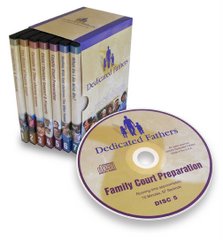
Order the Dedicated Fathers Audio Series Now!
Tuesday, January 9, 2007
Your Divorce or Child Custody Plan

WHAT YOU MAY WANT TO DO (or not do)
IF YOU SUSPECT A DIVORCE OR PATERNITY ACTION
MAY HAPPEN AGAINST YOU
www.dedicatedfathers.org
If you have never been involved in the family court system I can tell you the experience will leave you confused, frustrated and anxious. I have assisted in thousands of cases in the last 25 years, therefore I have learned a lot about the “game” of family court. Below is a list of the significant bullet points which I have gleamed from my years of experience at United Fathers of America. Not all of the bullet points will benefit every person, but every person will benefit by reviewing all of the bullet points. Each reader will need to determine which points are critical for their situation. Again, your primary job is to make decisions about your life. The bullet points below are presented to assist you in making those decisions.
WARNING: Different states have different laws as to what you can and cannot do AFTER a divorce or paternity action has been filed and served. Therefore, the following information is provided as general information for the reader to consider upon the happening of the contingencies as noted. In other words, there may be some things you will want to consider doing BEFORE any papers are filed and restrictions are then placed on what you can and can not do. The following is not a substitute for sound legal advice, it is intended solely to produce critical issues for the reader to consider.
1. You may not want to listen to family, friends or co-workers.
Family, friends and co-workers have an emotional relationship with you. Although well intentioned, their information is based on their experience - not yours. Typically, if you get too excited, they will bring you back down with stories of how hard it can be. Likewise, if you get too depressed, they will lift your up with success stories. In family law, you need sound objective and unemotional answers to your real life questions. As in all of life, in family law information is power - the power you need to make the right decisions for your current and future life.
2. You may want to develop a healthy suspicion of any advice or suggestion given by someone who stands to earn money directly from that advice or suggestion (such as attorneys or paralegals).
Remember, their information, education, tactics and strategies are based on the fact they stand to make money off of you if you follow their advice or suggestion. In other words, they have a financial vested interest in what they tell you. On the other hand, you need to be a pro-active partner with your attorney or paralegal. If you can not get objective unemotional and unattached answers to your real questions from co-workers, family, friends, attorneys or paralegals, then from whom do you get the information and education you need?
3. You may want to seek out a nonprofit organization.
The best way to become involved, informed and educated is to seek out a nonprofit organization or group in which you have faith and in which you feel you can trust and rely upon. Do some research, find out about their reputation, then use this nonprofit group or organization as a sounding board for what is happening in your case and listen to their suggestions and experiences. This series of articles is a great way for you to gain education and information to consider for your case.
4. You may want to gather any and all information you can about divorce or paternity actions. Knowledge and information is power in the family court game.
5. You may want to put together a record of all marital facts including, but not limited to, a list of all assets and all debts.
Get together copies of all tax returns, copies of all pay stubs, copies of all bills including, but not limited to utility payments, credit cards, car payments, house purchase agreements and monthly payments, a list of any and all other bills or expenses, a listing of all assets such as your cars, house or major purchases, etc., and a copy of all important papers such as life, auto, home or medical insurance policies and copies of all retirements accounts. In other words, a copy of anything and everything dealing with any form of asset, debt or important papers. If you do not have, can not find or can not get your records, seek out a good nonprofit organization. With years of experience, they can assist you in obtaining your records. You do not need to hire a high priced attorney to do that which you can do for yourself.
6. You may want to start and maintain a written log, journal, diary or history of all significant events, no matter how small they may initially appear.
Many things are going to be happening in your changing world. Hopefully, most happenings will be peaceful. However, it may be critical to document events for future hearings or other legal actions. You need to note such events as the dates and times when you have the children with you, when you paid support (and how much you paid), and other relevant events. In other words, keep a chronological diary (with pictures if possible) of all family law related events or situations. Consult your support group, paralegal service or attorney for additional specifics of what needs to be documented.
By: Marvin Chapman & Dedicated Fathers
www.dedicatedfathers.org
Go through your divorce knowledgeable and in control.
Order Dedicated Fathers Today!